
By the end of this article, I will ask you to flip a coin and whatever the resulting challenge is, you have to do it.
Pedro Almodóvar is a Spanish film director, screenwriter, and author most famous for his works Women on the Verge of a Nervous Breakdown (1988), All About My Mother (1999), Talk To Her (2002), and The Skin I Live In (2011). His films are characterized by their exploration of themes like gender identity, motherhood, sexuality, and desire, and by their stunning visuals and vibrant colors. That is about as much as you will learn from a simple search about Almodóvar. His hair will be voluminous no matter what photo of him you see, his films will be rated highly regardless of whether you’re measuring in letterboxes or moldy tomatoes, and his cult following is easily seen through the image search bar, where you might run across this shirt on sale for twenty-one USD or this hat for twenty-seven:


What you won’t find on a quick search is what I found the second time I watched one of his films. But before that, let me tell you about the first:
Women on the Verge of a Nervous Breakdown, circa last summer. I’m sitting in a perfectly air-conditioned movie theater, popcorn in one hand and Diet Coke in the other, when the lights dim and this masterpiece starts playing. The plot of Women on the Verge of a Nervous Breakdown follows voice actress Pepa, who, after her partner Iván leaves without explanation, sets out to find the reason but ends up finding herself instead. In the following two days, she encounters a host of peculiar characters, such as Iván's ex-wife, Lucía, who has prematurely been released from a mental hospital, her fidgety friend, Candela, who unknowingly got involved with a Shiite terrorist cell, and her possible tenant, Marisa, who unknowingly consumes an unhealthy amount of sleeping-pill-spiked gazpacho.
During the eighty-eight minutes in which I was wholly absorbed by this empowering feminist movie, I laughed, I cried, I gasped, I unwound, and life was sunshine and rainbows. Seeing a movie centered on such profoundly written women that takes the romantic reunion trope and shatters it to oblivion, all the while showcasing such strong colors and visuals, was a religious experience. God is, as Almodóvar makes it, a woman.


So surely, surely, a director who has done such a fantastic job representing the agency and complex psyche of women in one film can’t possibly make another that is nauseatingly and abhorrently sexist, right? Unfortunately, I’m writing this article for a reason.
Three weeks after watching Women on the Verge of a Nervous Breakdown, I went to the same theater with the same air conditioner and snacks to watch Talk To Her. Talk To Her follows two men who form an odd friendship while they “care” for two women who are both in deep comas. Benigno is a tireless and devoted nurse to Alicia, a coma patient and former dancer. Marco, who is the protagonist of the film, is a sensitive and sympathetic journalist whose bullfighting girlfriend, Lydia, falls into a coma and is treated in the same hospital. Marco and Benigno become friends, and Marco learns more about Benigno and about how to “care for” a comatose woman (I say in strong quotation marks). As the movie unfolds, the viewer learns that Benigno stalked Alicia before she became his patient. In fact, he got the job as a nurse in the coma care facility after she fell into a coma, and, from then on he raped her.
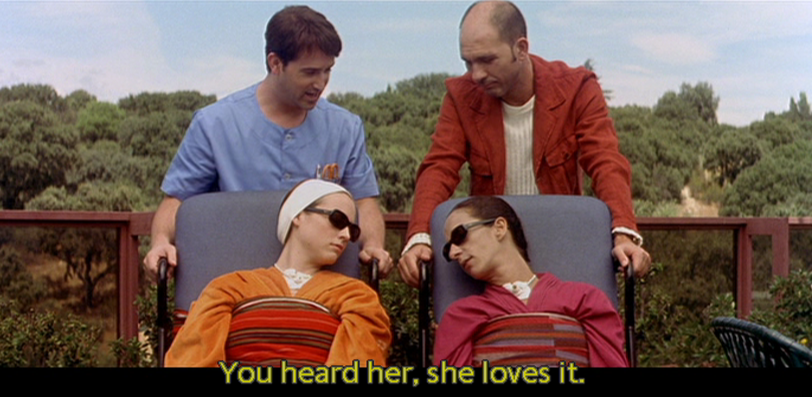
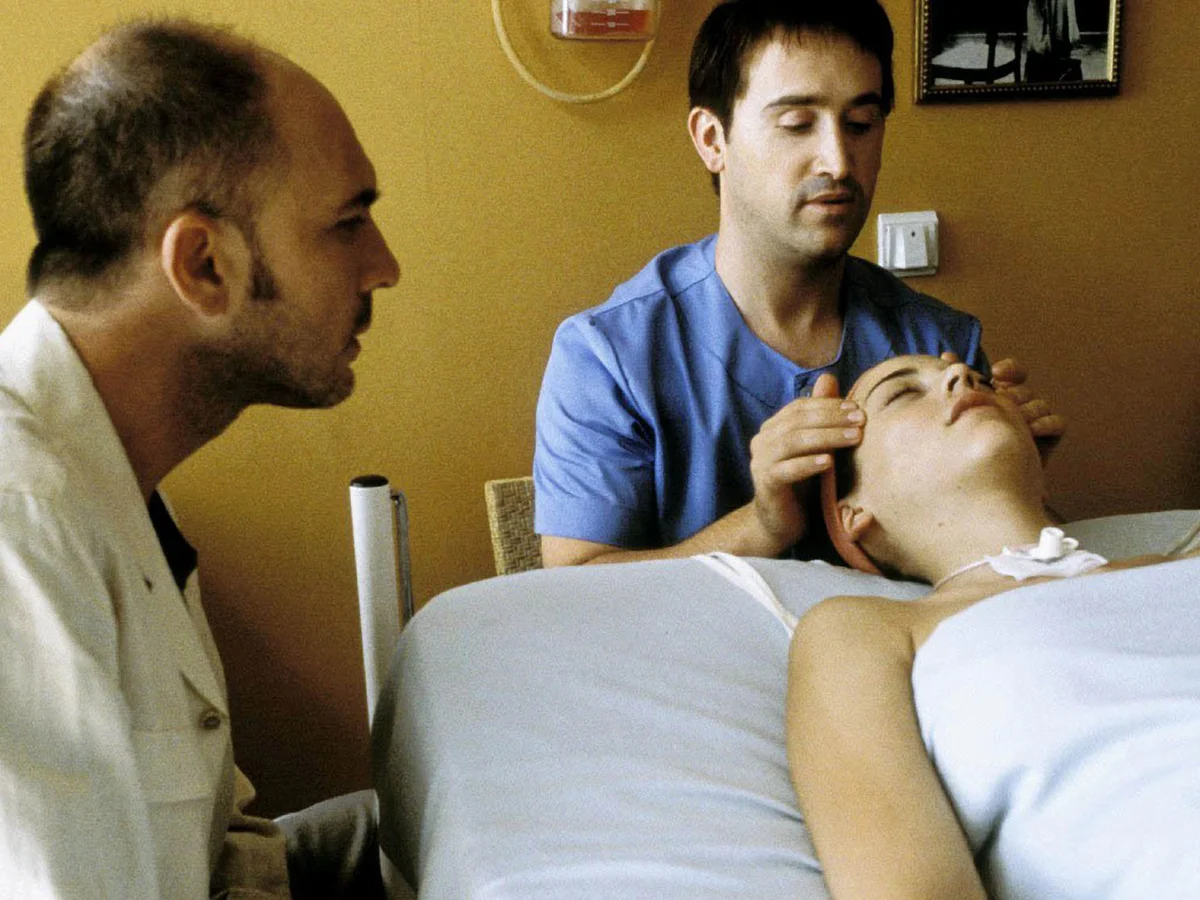
The unspeakable evil of Benigno’s actions is amplified by the fact that the film is designed to encourage the viewer to root for Benigno. The score of the film is arranged to provoke sympathy for Benigno when he faces repercussions; the script and framing of the scenes favor Benigno or Marco, who roots for and believes in the innocence of Benigno; and even his name means benign. If this weren’t misogynistic enough for you, you’re in luck. Almodóvar reaches unforeseen levels of sexism in this film, whether it be with how the unconscious women’s bodies are constantly objectified and visibly violated, or with the horrid 7-minute silent film inside the film about a man who unintentionally drinks a shrinking potion and burrows himself inside (the unrealistic and outright offensive depiction of) his lover’s vagina.
In Talk To Her, Almodóvar rids women of the agency that he was so generous with in Women on the Verge of a Nervous Breakdown. I can confidently say that Almodóvar intended this movie to be a horror movie and not the drama/romance that IMDb claims it to be. In other words, I believe that Almodóvar may have intended a critique, but the film’s construction invites the opposite reading. So if I didn’t know his principles and previous works, I might be left to think that Talk to Her is not scrutinizing misogyny but rather promoting it. That raises the question: what if some of the people calling this film “moving” or (rather ironically) “touching” aren’t actually talking about the criticism of the anti-woman lens of the film but rather the actual narrative, the friendship between the abuser and the forgiver, Benigno and Marco?
And this is what terrifies me: that similar to films like F**** C*** or American Psycho, Talk To Her has reached an audience that it originally intended to criticize. What makes it worse is that the movie doesn’t just seem to promote a patriarchal culture or mindset either, but it appears to excuse or even encourage the violation and objectification of women’s bodies. And what’s even worse? This is only one of many Almodóvar films that criticize misogyny by showing it to the extreme.
Now that you’re familiar with Almodóvar and can watch his films with an informed perspective, it’s time for you to flip a coin. If it’s:
HEADS → Congratulations! You will be watching Women on the Verge of a Nervous Breakdown or any of the other light-hearted feminist comedies by Almodóvar, including All About My Mother and Volver. Enjoy the laughs and the strong complex characters!
TAILS → Congratulations? You will be watching Talk To Her or any of Almodóvar’s other seemingly misogynistic films, including Tie Me Up! Tie Me Down! and The Skin I Live In. Challenge yourself to separate your perspective from what the film is forcing you to see.