
On November 13th, 1976, Carol Burnett walked down an elegant studio-produced staircase in one of the greatest costumes of television history: the green curtain dress. The scene came from Went with the Wind!, a comic skit from Burnett’s sketch comedy show, that both humorously satirized and respectfully paid homage to David O. Selznick’s acclaimed 1939 film Gone with the Wind. The dress itself was designed by Bob Mackie, a fashion designer who produced outfits for various celebrities, and who served as the lead costume designer for the Carol Burnett Show. It was Bob Mackie’s vision that brought the curtain dress to life, a dress that is now preserved in the annals of American culture in the Smithsonian’s Museum of American History in Washington, D.C. However, despite being the most recognizable, the green curtain dress wasn’t the only dress Mackie designed for Went with the Wind!. Indeed, Mackie designed all of the costumes for the sketch. Given Mackie’s recent tragic passing on September 14th, it would be worth looking back on his legacy through a tailored lens that analyzes the brilliant way he managed to bring smiles and laughter through his costumes for the classic comedy. To that end, I’ll consider how Bob Mackie transformed the source material from both Margaret Mitchell’s 1936 novel Gone with the Wind, as well as the 1939 film, into his costumes for Went with the Wind!
The Antebellum Outfits
The sketch opens on the Tara plantation, which is renamed “Terra” in the show, with an establishing shot of cavaliers and belles in elaborate costumes that are almost fully covered by a giant white title card that places the location as "Somewhere in Georgia,” a humorous nod to the fact that Mitchell’s novel was primarily set in little-known Jonesboro, Georgia. After setting the stage, the camera moves into a close up shot of Carol Burnett playing “Starlett O’Hara” who is evidently based on Scarlett O’Hara, the anti-heroine of Gone with the Wind. Burnett’s dress is inspired by the iconic dress Scarlett wears at the 12 Oaks Barbecue towards the beginning of the novel and film. Walter Plunkett, who designed the original film’s costumes, designs a stunning hoop-skirted dress with vegetal motifs and a sun hat whose trailing green ribbon is tied against Starlett’s chin. The dress itself has been replicated onto Barbie dolls and is one of the signature costumes from the film. For the parody, Bob Mackie substitutes the long green ribbon with numerous tiny ribbons interlaced throughout the outfit. The dress also features a green choker with a locket and purple flowers spread across the bodice. On the whole, the dress remains faithful to the original and clearly recognizable, despite accentuating the original dress’s flashy and ostentatious qualities. The flashier qualities on Mackie’s dress are what initially reminds the audience that they are viewing something slightly different from the original, but aside from the subtle changes, Starlett’s 12 Oaks Barbecue dress is relatively similar to the original.
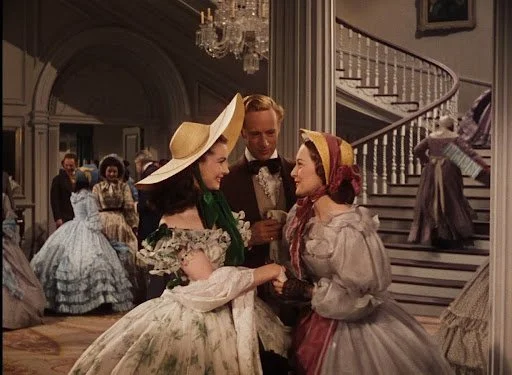
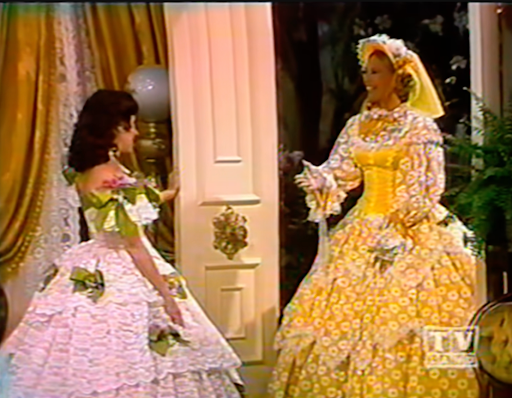
The first outfit where Mackie’s comic brilliance really shines (literally) is the dress he designs for Melanie Hamilton or “Melody” in the skit. In the novel and movie, Melanie is known for her sweet, caring, and noble qualities, which sets her up as a stark contrast to Scarlett’s obstinacy, slyness, and gumption. Melody’s dress completely departs from Melanie’s outfit in the film. In the film, Melanie wears a modest, dull lavender dress with a sunhat and a trailing magenta ribbon tucked under her chin. The film creates a parallel between the two through their costumes, which resemble each other closely, apart from the fact that Scarlett's outfit is much more daring, extravagant, and dramatic, demonstrating how Scarlett is the clear center of attention at the barbecue. In the novel, Mitchell refers to Scarlett’s attire as an “afternoon dress” that was “not suitable for a barbecue, for it had only tiny puffed sleeves and the neck was low enough for a dancing dress” (Mitchell, 91). Scarlett’s choice to wear an afternoon dress to a daytime event reflects her rebellious nature and the fact that, neither her composed mother Ellen nor her moral compass Mammy, can actually contain her indomitable spirit. Scarlett’s resistance towards the status quo is one of her defining characteristics, and indeed, Scarlett reacts passionately and vociferously against the rigid strictures of Southern society. To Scarlett, Southern customs of wearing black dresses for extended periods during times of mourning or certain dresses depending on the time of day are social enclosures she works to evade and work around. In this sense, it makes perfect sense that Scarlett’s dress at the Twelve Oaks Barbecue flies boldly in the face of the standards of the social event. On the other hand, Melanie represents the Southern establishment; she passively and, at times, blindly follows the teachings of the South. Perhaps the best example of this contrast between Scarlett and Melanie can be seen at the scene of the Atlanta Charity Bazaar in the novel, an event that features long banners of Jefferson Davis and Alexander Stephens as decoration. In the novel, Scarlett comes to realize the strange and sacrilegious idolization of these figures of the Confederacy, mockingly thinking that the figures could pass as an “altar” to the “Father and the Son” (Mitchell, 178). In her internal monologue, Scarlett starts “arguing with her conscience,” realizing that the two “aren’t anything but men, and mighty unattractive looking ones at that” (Mitchell, 178). In this central turning point of the novel, Scarlett looks around at the women with tears in their eyes, including Melanie, who are willing to give up their lives for the so-called “Cause,” and she realizes that “it just seemed silly” (Mitchell, 177). Despite being an internal monologue, the scene is central to the novel because it demonstrates Scarlett's resistance to the homogenous ideology of her society, a recurring trait of her character. On the other hand, Melanie firmly believes in the Confederate war effort, and when Melanie looks around the Bazaar, she wonders why more of the young men weren’t contributing to their national duty and serving in the war (Mitchell, 182). Melanie firmly stands by her society through and through, and her character embodies the Old South with its rigid adherence to obsolete and outmoded customs. Thus, Melanie’s modest dress, which does not draw attention to herself in any way, fits brilliantly with her modest and unassertive character.
However, Mackie’s dress for Melody swaps out the dull colors for a warm, radiant yellow, a bridal veil on her head, and white little daisies sprinkled throughout the yellow sheen of the dress. The dress is sickeningly sweet and saccharine and absolutely over the top in establishing Melody's extreme sweetness. That sweetness is even played for gags, when Starlett tells her to throw her head into a punch bowl to add some sugar to it, which she eagerly and readily agrees to, as if it were her life’s mission to follow what others tell her. Mackie’s dress turns Melanie into a ball of sunshine who frolics around in fields of daisies while she sings songs from the Sound of Music. The dress is absolutely over the top and one of the most attention-driven outfits in the entire sketch, a costume that I believe represents one of Mackie’s greatest triumphs in accentuating the humorous qualities of the original characters from this classic American film and novel.
The Reconstruction Outfits
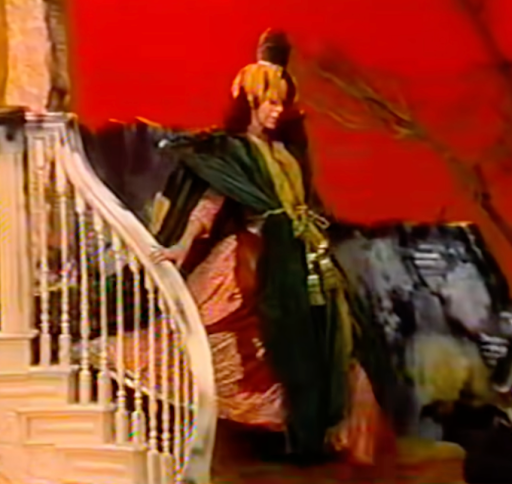
The chronological order of the sketch almost completely skips over the wartime outfits of the characters, which is perhaps reasonable, given this portion of the novel and film aren’t exactly exuberant or humorous in tone. Perhaps the most notable Reconstruction outfit that is worth being discussed is the aforementioned green curtain dress. The surrounding context for the entrance of this dress is that Scarlett’s home has been left in shambles from the aftermath of the Civil War, and she needs money. The only person she knows who might have money is Rhett Butler, but she is in completely disarray and has lost all her fine clothes. However, when looking at the curtains on the wall, she gets an idea. Bob Mackie deeply considered how to execute this dress. In an interview, Mackie explains how difficult he found it to turn this dress into something humorous for the sketch. He states, “I couldn’t figure out what to do. It said Scarlett takes the drapes off the window, goes upstairs, and comes down with the drapes just hanging off of her. Well, that wasn’t very funny.” And, Mackie was right; the original dress was far from comic in its connotations. The story of the original curtain dress is one borne of absolute desperation, and it demonstrates the resilience of the human spirit to withstand the cruel forces thrust upon man as well as the ability to take fate into your own hands. Bob Mackie proceeds to take all that and gives us this. The camera pans upward and follows Carol Burnett walk down the staircase with a literal curtain rod as the shoulder piece of the costume—the tassel fringes of a curtain serving as the hat. The Carol Burnett Show was filmed in front of a live studio audience, and the eruption of laughter that poured out as Scarlett walked down the staircase in that outfit was almost unrivalled, which Mackie attests to in his interview. Indeed, the laughter in reaction to the curtain dress became one of most famous in the history of the Carol Burnett Show. It was Bob Mackie’s iconic dress of Starlett quite literally becoming the curtain itself that made that possible.
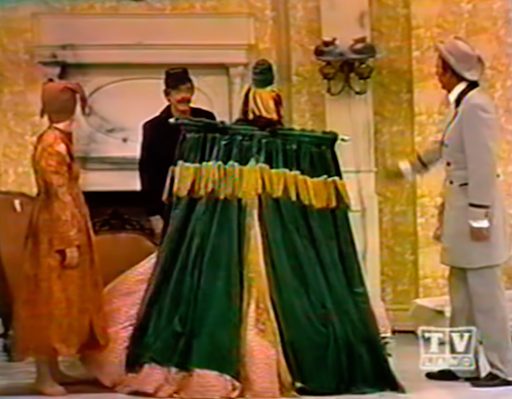
Bob Mackie’s costume design for Went with the Wind! has led to costumes almost as iconic as those by Walter Plunkett for the original movie. Films like Gone with the Wind, Meet me in St. Louis, or Breakfast at Tiffany’s pose unique challenges for parodies in terms of costume design because their costumes hold such legendary status that changing them in any way might be considered a grave sin of sacrilege by some fans of the original work. Only a costume designer like Mackie could transform costumes that stand like untouchable pillars of Hollywood history into something unique, original, and completely unforgettable. Mackie manages to take the famous and fabled, then double down on it by accentuating what made it brilliant in the first place, leaving an indelible impression on the audience in the process. For this reason, whether it be his spoofs on Scarlett and Melanie’s dresses from the Twelve Oaks Barbeque or the revered curtain rod dress, Mackie will never really have “went with the wind.” His legacy lives on in a refreshing breeze that still sends goosebumps down those who have the privilege of witnessing his brilliant costumes for the first time.