
Narrow corridors, empty rooms, and sallow walls constitute the mise en scène of Chantal Akerman’s feature debut, Hotel Monterey (1972)—her first exploration into the suffocating confinements of urbanity. Akerman’s commitment to rigid structuralism, achieved through impulsive direction, is brilliantly betrayed in a film where rules are established to be compellingly broken; a hotel’s narrow walkways exist as a latent metonymy of the Unreal City’s slowly revealed inhumane labyrinth.
We begin in the hotel’s lobby. As Hotel Monterey is a silent film, we watch the eerie, gestural talk of several anonymous guests, their faces blurred with heavy film grain. Akerman’s unscripted documentary coldly receives these movements devoid of context. Composed entirely of long takes and static shots (a pattern that continues through the majority of Hotel Monterey), this first section of Monterey’s anatomy concludes with the view of an elevator’s inner doors. There is a degree of suspense, as, from the camera’s position, the viewer has no way of knowing whether the elevator is empty or if an interlocutor lingers out of frame. Yet the focus is not on these human guests; any interest in these speechless, automaton lives is subverted.
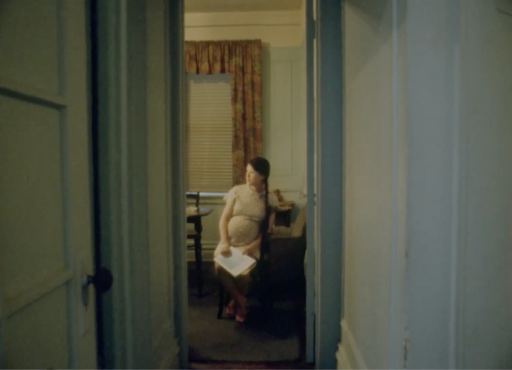
A sitting woman with a manuscript possesses wax-figure stillness. The composition is unnerving.
Akerman then shows us a series of bedrooms, where the men and women inside are curiously unmoving. An elderly, aristocratic gentleman, out of place in the hotel’s general ramshackle, sits and stares into space with a vacant, wax-figure’s smile. A doll-like young lady, legs crossed, faces away from the camera in a sickly green room. A pregnant woman, seen through a cramped doorway, wears a blank face and holds a neglected manuscript. Interspersed with these three figures are shots of sinks, toilets, empty beds and empty chairs. The human body is analogized as furniture within this hotel’s haunted grounds. Hotel Monterey is an environment for the lifeless—a conclusion reached through Akerman’s method. Through minute-long takes, the viewer is granted ample time to explore the light patterns, corners and each grain of a given image.
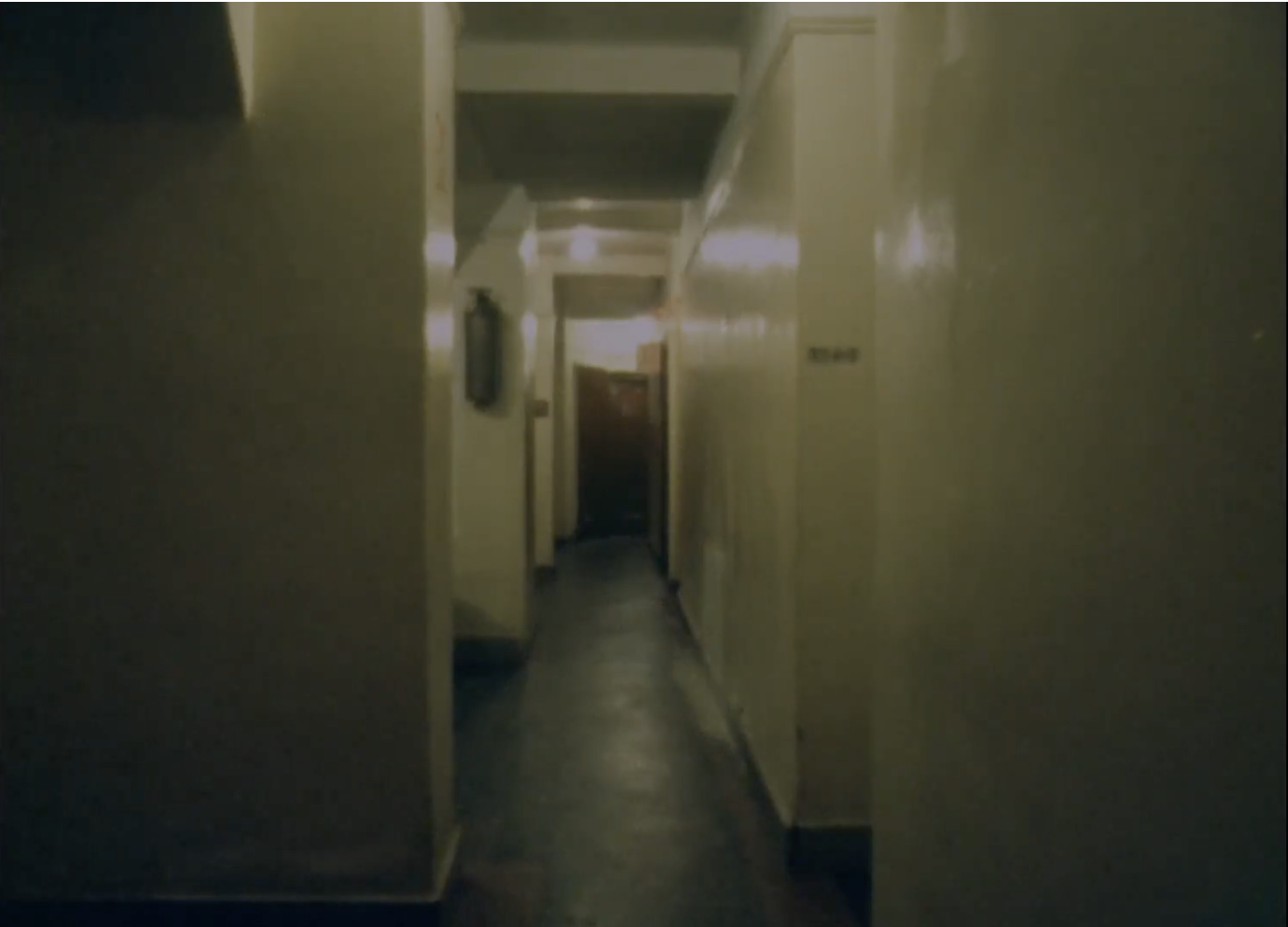
The camera lingers. One can find distinction in this monotony.
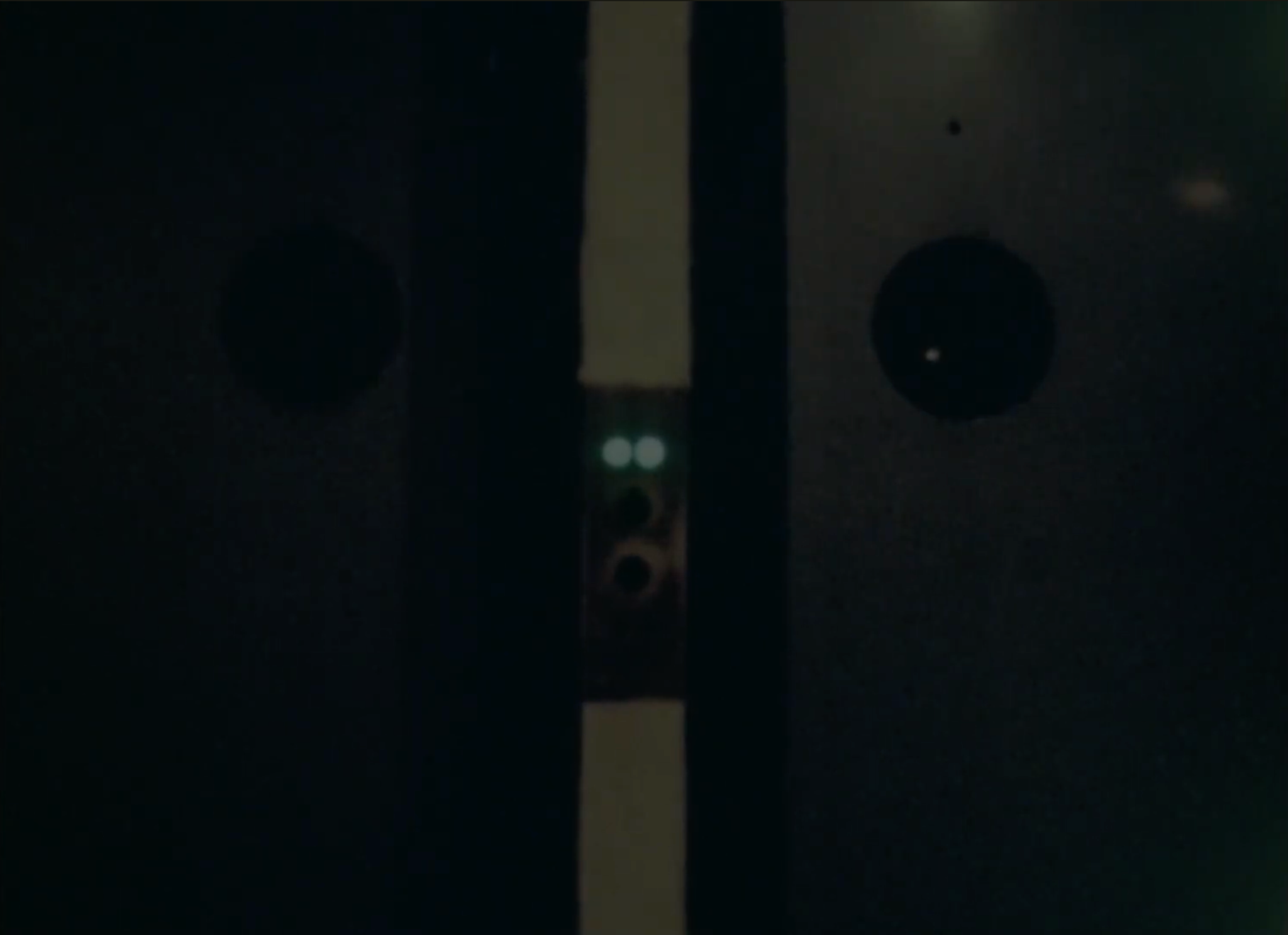
What follows is a series of deep, dark, and empty corridors. The camera sometimes lingers, motionless, on long hallways lit only by cold, industrial lights. The halls are largely uncarpeted—sallow walls reflecting a dull glare—without a single person to walk their grounds. Akerman shows us but one woman, the last face we see, who peeks out momentarily from her door before quickly pulling it shut. Later on, we are again by the elevator, this time watching its outer doors. Lights flash around a control panel, but, without sound nor peripheral context, its patterns of mechanical flashing seem senseless and without order.
Suddenly, in the film’s final quarter, the camera moves. In several identically structured shots, the camera lumberingly approaches windows at the ends of a series of hallways. These are the first windows, the first suggestions of an outside world and of a reprieve, that Akerman’s film has allowed for. Yet she frustrates any view towards an outer environment. When the camera reaches a window, the exposure is either too bright or too dim, and the most a viewer can make out are faint outlines—or, at one point, the suggestion of a freeingly broad blue sky. Four times the camera rolls towards a window, and each time it unfailingly pulls back, denying detail and satisfaction to the audience.
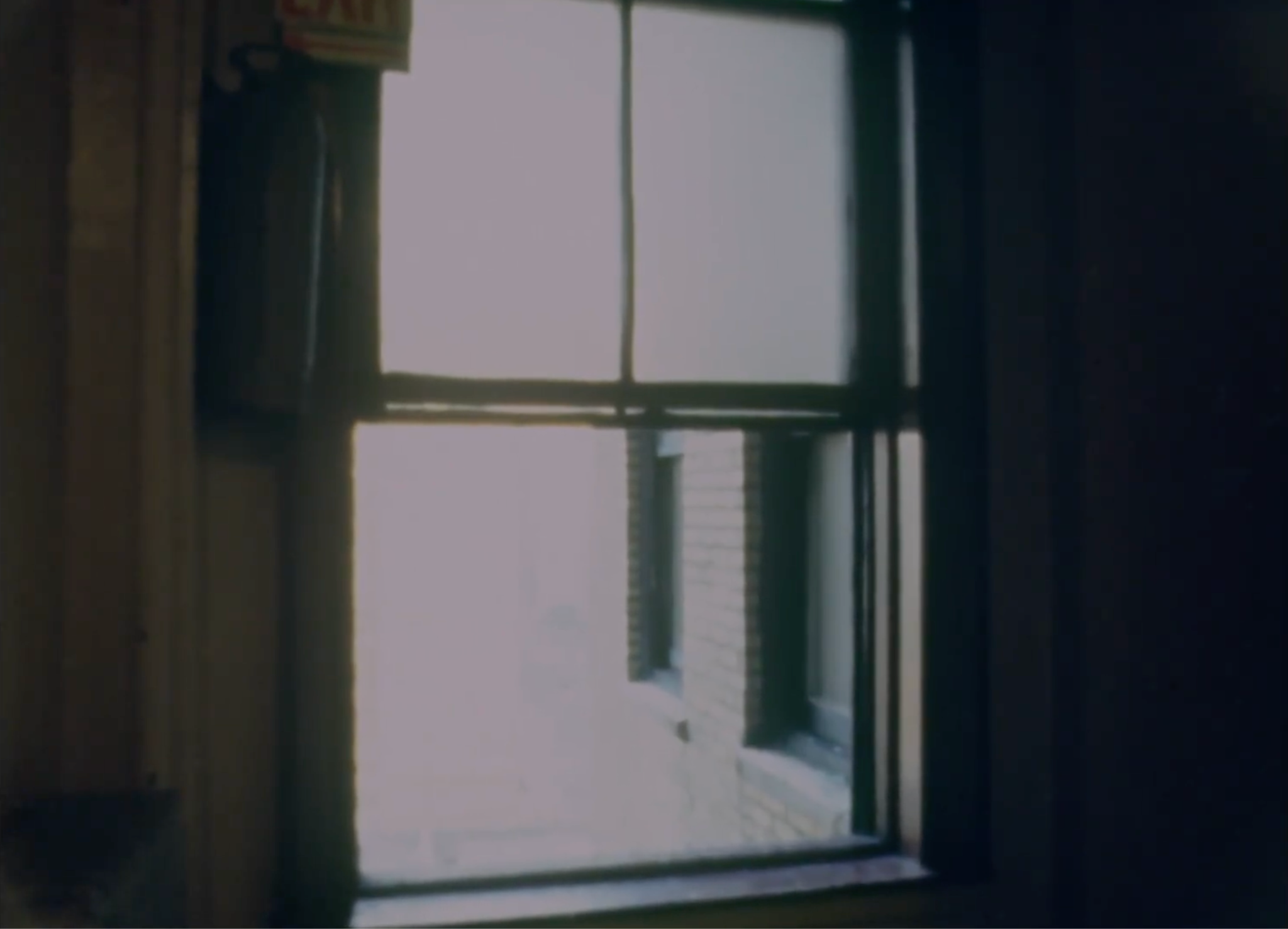
The camera moves past a window, but the view outside is obscured.
Akerman concludes her film with a set of disappointments. She again breaks the rules, as the camera now displays scenes from balconies and rooftops—it has left the corridors to focus on the surrounding vistas. Outside Monterey’s confining corridors and cramped rooms, all trembling for dissolution, is yet another maze, composed of buildings that block the sky and constricted city streets. Occasionally the camera will turn upwards for a glimpse of the sky or rest upon a thin patch of river between the skyscrapers, yet on the other side of this river are smokestacks. New York City is presented as a continuation of this hotel—and the hotel, a part and parcel of the city. From every viewpoint, the haunted Hotel Monterey is inescapable; the mechanical, manifestly inhuman hallways are streets that turn and return into other lifeless rooms. We realize that the blue sky suggested earlier at the window was nothing more than light from an invisible sun reflected across skyscrapers.
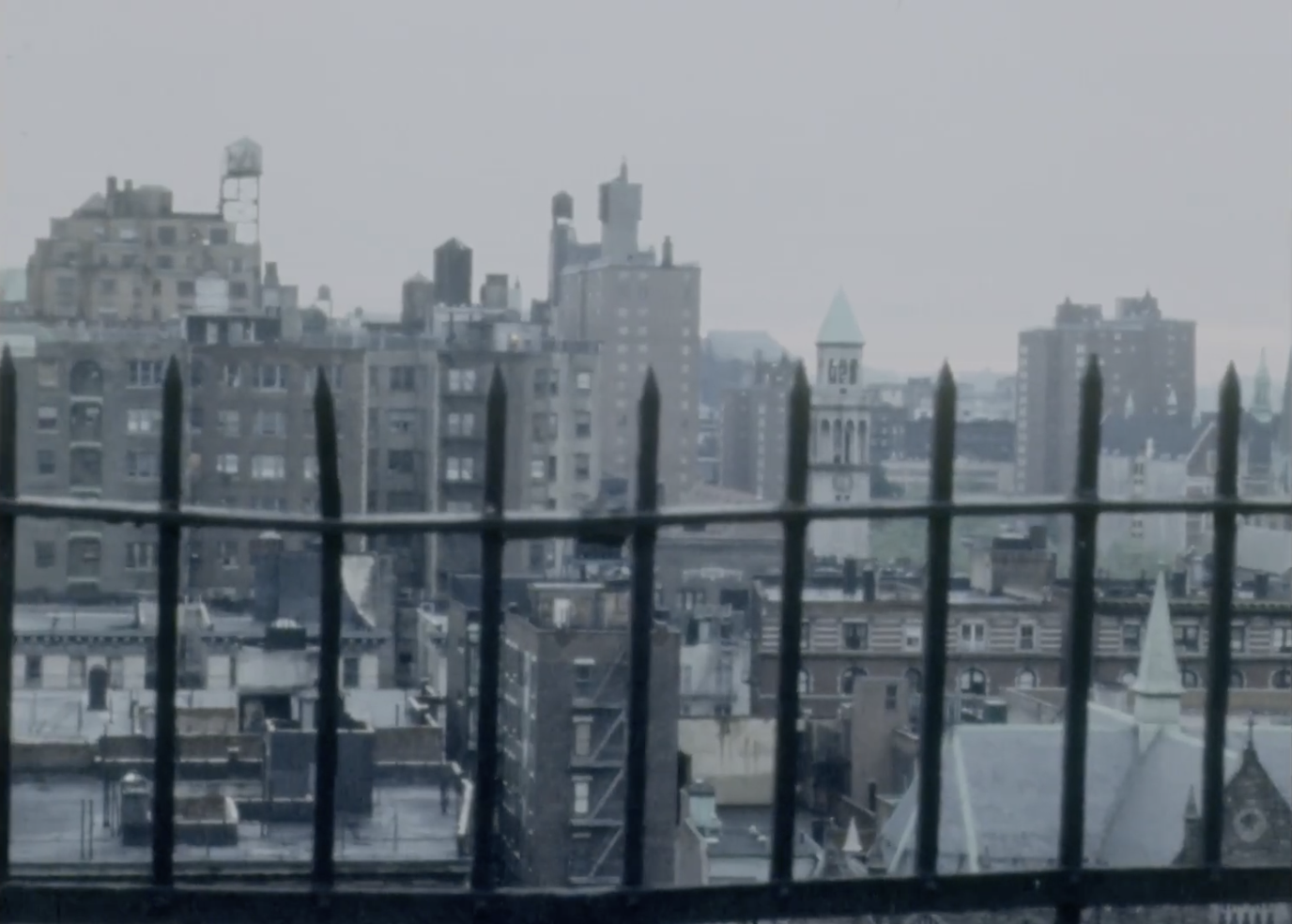
The city, itself a barrier, is seen through a spiked fence.
The urban maze, as depicted through the entrapping vessels of apartment rooms, presents a vital concern throughout Akerman’s major works, where it is associated with psychological sickness, loss, and alienation. It is in a kitchen’s confinements that Jeanne (Delphine Seyrig, Jeanne Dielman, 1975) first betrays her madness. In No Home Movie (2015), the death of Akerman’s mother is portrayed through nothing more than a long take of an empty apartment. In Les rendez-vous d'Anna (1978), Anna (Aurore Clément) lays on an unlit bed, listening to a series of messages from sex opportunists, rambling over pleasantries, that confirm her loneliness. Anna is waiting to hear from a woman lover that she will never speak to again. Notably, Akerman’s first short film, Saute ma ville (“Blow this town,” 1968), set in a highrise kitchen, ends with Chantal herself immolating an apartment.
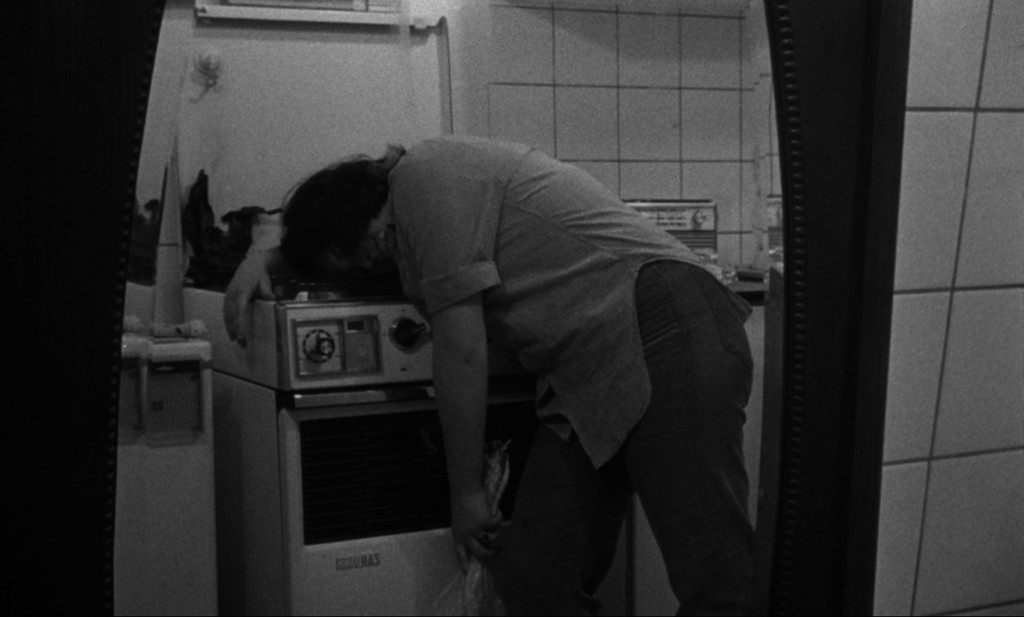
Saut ma ville (1968), introducing Akerman’s interest in captivity, ends with an exploding oven. The act echoes the death of Sylvia Plath, a major inspiration on Akerman’s work.
When I think of Hotel Monterey’s ending revelation—its set of further walls—I am reminded of the different challenge in the concluding frame of Andrei Tarkovsky’s Nostalghia (1983). The visiting Russian poet Andrei Gorchakov (Oleg Yankovsky) has been sickened by Tuscany, a cultural heartland imbued with a Gothic aesthetic so offensive and antithetical to his Slavophilic constitution. He is sickened by the extravagance, and he dreams of his childhood: his dog, his home, a simple, ascetic nature and his mother.
At a public bath, Gorchakov meets a madman. Domenico (Erland Josephson) was arrested for locking his wife and children away from the outer world—his neurosis pushing him to board up his windows in an attempt to shelter his family’s innocence from moral corruption. Following Domenico’s advice, the Russian tourist attempts to walk a lit candle across the bath while sustaining its flame. He stops midway, his candle out, re-lights, and realizes it’s only possible if he holds his breath. He begins anew with a more measured gait. As he puts the lit-candle down at the bath’s opposite end, he suddenly collapses and dies of asphyxiation.
His death dream returns us to his childhood garden—an image that is the heart of his heart; the very fulcrum of his life. Now an old man in the shelter of his youth, he gazes across the quiet grasses, but something is wrong; we see it first in the reflection of a small pond. Drawing back the camera, Tarkovsky reveals that Andrei’s homeland is now surrounded by immeasurably great, ruined Gothic monastery walls. The candlelight can only be preserved at the cost of one’s life. Idealism is a lunatic’s fantasy upon which reality inevitably intrudes, Tarkovsky seems to say. While the situation can be denied, it cannot be avoided; one will always find the limits of their daydreams in Hotel Monterey’s encasings, the walls of the city or of the monastery.
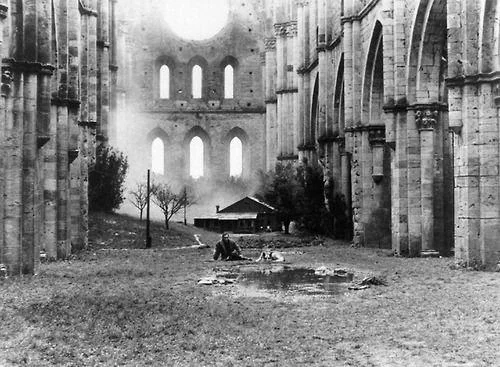
The childhood sanctuary, entombed. The image has stuck with me.
While Tarkovsky means to speak against the fragile ideal, I wonder if one might not, with Monterey’s message in mind, read this image differently, even affirmationally. Outside the hotel are only colder, crueller corridors, nothing of beauty within or beyond the walls. Yet, we may recognize the walls and our tendency towards irreality while giving credence to our daydreams. We can remember the ideal and paint a more wondrous image over the peeling wallpaper, making nest within an environment so manifestly lifeless. Nostalghia’s protagonist finds room for melancholic recollection in a stifling Romantic country. Watching the dull interiors of Hotel Monterey, it is, after all, not an uncommon experience to perceive movement where there isn’t any. It’s even a virtue of this film that one finds their mind wandering while watching.
I think of some lines of Italo Calvino, where he imagines hell as the condition of daily life, and those answering words of advice:
Recognize who and what, in the midst of this inferno, are not inferno, then make them endure, give them space.