
WARNING: Spoilers for Heretic ahead. I strongly recommend watching it first.
If we share similar Instagram reel algorithms, you might have stumbled upon the scene that convinced me to watch Heretic (2024). In this scene, Mr. Reed (Hugh Grant) uses different versions of Monopoly and the similarity between Radiohead's "Creep" and The Hollies' "The Air That I Breathe" as analogies to explain how different religions are iterations of each other. Mr. Reed says that over time, these iterations "dilute the message" and "obscure the original".
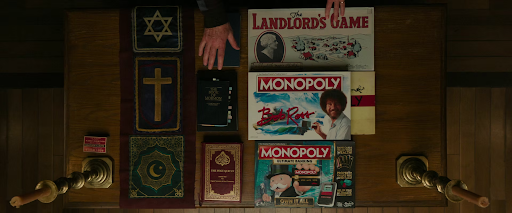
Awesome analogy aside, this scene, as well as the rest of the film, confronts an issue with organized religion: There is a sense that, over time, the original purity and intent of some religious teachings have been diluted or deliberately manipulated to serve human agendas while the teachings themselves are being established as self-evident and incontestable. In other words, while religions began as an effort to understand the divine, in some instances like cults or oppressive theocracies, they are being used as unquestionable dogmas and laws that only profit the ones in governance. Heretic’s claim is that questioning religion is not a blasphemous act, but the very thing that allows people to keep their free will and prevents them from being coerced. In the film, conflicted Sister Barnes (Sophie Thatcher) and confidently devout Sister Paxton (Chloe East) are captured by Mr. Reed, who has turned his house into a maze designed to challenge their faith. And as the Sisters try to escape, the viewers are encouraged to question faith and religion alongside them.
What makes the movie’s take on skepticism and belief so much more interesting is how Beck and Woods approach the subject with ambiguity and objectivity. There is no obvious message persuading you to be a skeptic or a believer because the film ends in a way that leaves the viewers to choose between faith in a miracle, and suspicion of an unreliable narrator. (SPOILERS) By the ending of the film, Sister Barnes, who was previously murdered by Mr. Reed, miraculously resurrects following Sister Paxton’s prayers. After she comes to life, she kills Mr. Reed and saves Sister Paxton. Paxton escapes Mr. Reed’s house and sees a butterfly resting gently on her finger. This calls back to a scene where she says she would become a butterfly to communicate with her loved ones from the beyond. However, in the final frame of the film, the butterfly vanishes.
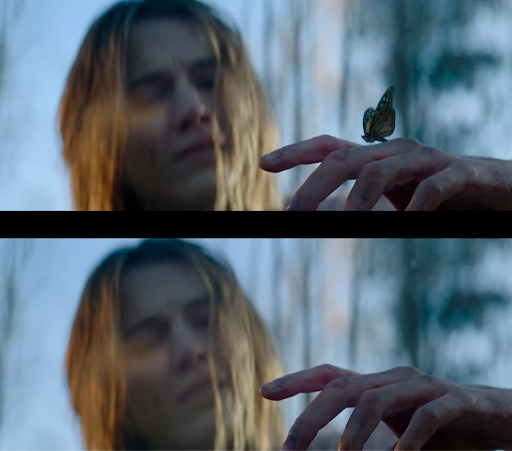
In my opinion, there can be two main interpretations of this ending: belief vs disbelief. On the one hand, the resurrection of Sister Barnes could truly be a divine miracle and a sign that Paxton's faith, no matter how tested it was, is finally rewarded. However, this interpretation requires you to turn a blind eye to the final frame—the one frame that doesn’t coincide with the rest of the narrative, just as religious beliefs require you to believe in miracles and supernatural occurrences that don’t coincide with the laws of science. If you choose to recognize that the butterfly disappears and deny this interpretation, then you have to accept that Sister Paxton died and never actually escaped the house. The ending in its entirety would have been a hallucination produced by Paxton’s brain in its dying moments. Therefore, the apparent resurrection of Sister Barnes, the escape, the butterfly, and the happy ending would all have been an illusion. This gloomy interpretation acts as a representation of atheistic beliefs, and how atheistic explanations that comply with scientific truths deny their believers the comfort of ideas like “good behavior is rewarded” and “evil is punished”.
With the plethora of films out there that only serve the purpose of promoting specific religious beliefs, I find it refreshing to have watched a film that doesn’t tell me what to believe, but rather to be informed and skeptical before forming an opinion on faith. In the words of the directors Scott Beck and Bryan Woods, "the ambition is to deliver questions, and not to necessarily deliver an answer." There are many more questions delivered throughout the film that I haven’t mentioned, so if you would like to explore the mysteries of Heretic yourself and see some fantastic acting as well as beautiful cinematography by the legendary Chung-hoon Chung (The Handmaiden, Oldboy, Last Night in Soho), Heretic is available to stream on Hulu or rent with Prime Video.