
The Men Who Sleep
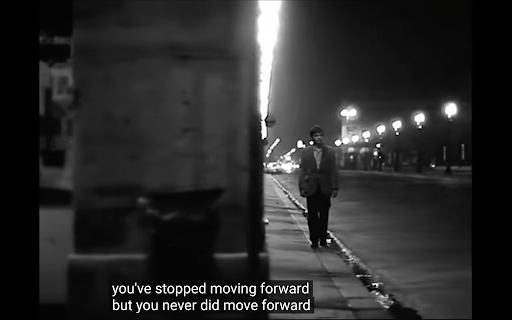
Un Homme qui Dort is a 1974 French film directed by Bernard Queysanne and Georges Perec, based on Perec's novel A Man Asleep. The film is the directorial debut of both Bernard Queysanne and Georges Perec. Much of the film's script is borrowed completely from the text of the novel itself.
I want to preface my interpretation with an acknowledgement that this film unmistakably touches on the consequences and side effects of depression: how depression can completely upend and cause such deep isolation from the rest of your immediate community.
However, it is undeniable that, following works like Perec’s, so-called “noble” nihilism surged in popularity—as a thematic muse for many directors and their devoted followings. The worldviews of many authors, as expressed in their writing, exhibit both the effects and side effects of a nihilistic outlook. Think of Camus, Kafka, Lars von Trier, Scorsese, and Kubrick—or films like Fight Club, Taxi Driver, and No Country for Old Men.
Today, it seems like many followers of this nihilistic philosophy regard it as a noble–or at least intellectual–outlook. To believe in a life that is meaningless; that one’s actions do not matter; to believe that the rational choice is not to play the “game” at all. Because what’s the point?
I recognize that this is a reductive reading of Nihilism as a whole–a straw man if you will (sue me). But watching Un Homme qui Dort, I come to the conclusion that the film is less a portrait of despair than a quiet indictment of the self-imposed exile of those who mistake disengagement for insight. In other words, nihilists are bums. Queysanne and Perec’s film can be read as a critique of those who justify anti-social behavior—not to be confused with introversion— with a be-all, end-all, such as “life is meaningless.” They suggest that those who do so have been led astray.
In a unique way, Nihilism is a self fulfilling prophecy. Its adherents do not uncover an inherent emptiness in the world; rather, by withdrawing from meaning, they help bring that emptiness into being. In claiming that life lacks significance, they perform that claim into reality—turning belief into condition. (Kant would call it the “world as one wills it to be”). The film visualizes this philosophical loop. Its grayscale Paris becomes both a symptom and proof of a self-authored detachment.
To consider one’s condition more absurd than it really is will never produce clarity about who you are or want to be nor where you want to go. There is no honor in over-abstracting your state of mind; no intellectual high ground in doing nothing because nothing matters. The film’s minimalism, its gray palette, its near-ritualistic repetition; these formal choices enact the same logic as nihilism itself. The more the protagonist retreats from meaning, the more meaningless his world becomes. Un Homme qui Dort does not depict nihilism; it performs it.
Queysanne and Perec compare stillness as a form of slow erosion. Watching becomes a substitute for living and perception replaces participation. Their film insists that to observe without engaging is a form of disappearance. Reality should be how you interact with it, not how you observe it alone.
The directors emphasize this idea through a recurring visual motif sprinkled throughout the film: Rene Magritte’s painting Not To Be Reproduced. One critic describes the work as follows:
For a starter, “Not to be Reproduced” challenges our perception of reality by presenting a visual contradiction. Magritte defiantly challenges the notion that our true identity is solely defined by our physical appearance. By presenting the man’s reflection as an absence or a distortion, the painting suggests that there may be more to our identity than meets the eye.
Yet Queysanne and Perec’s film reinterprets Magritte’s vision. A notable example is a scene where the protagonist sits in a multi-mirrored room that directly recalls Not to Be Reproduced. But instead of confronting his reflection, he turns his back to it.
Where Magritte’s figure doubts reality by facing it, anxiously searching for himself within the mirror’s refusal, the “man who sleeps” refuses to look altogether. The film thus inverts Magritte’s logic: it’s not that reflection deceives him, but that he has abandoned the act of reflection entirely.
In this inversion, Un Homme qui Dort reveals the true tragedy of its protagonist’s nihilism. His alienation isn’t born from the world’s indifference but from his refusal to engage with it.
This refusal is articulated most clearly through the film’s dispassionate narration. The voiceover, spoken in the second person, describes the protagonist’s life as if it were an autopsy of the living. “The unsurprising revelation comes to you,” it says. “Something has gone wrong, you don’t know how to live, you’ll never know.” You skip classes, avoid friends, sit “wedged between the couch and the bookcase with an open book in your lap. You stopped reading a long time ago.”
The film is not a drama, simply an observational documentary. The narrator continues, “the cigarette smoke rises in a straight or nearly straight line and spreads in a wavering layer beneath the tiny cracks of the ceiling.” You “don’t reject anything, you don’t deny anything, you’ve stopped moving forward, but you never did move forward.”
Each of these details by Queysanne and Perec enacts the same condition as Magritte’s reversed reflection: a life seen but not lived; watched from a distance; denied the dignity of participation. Again the only conclusion can be that the man’s stillness is not serenity but surrender; he exists only as a spectator of his own disappearance.
Un Homme qui Dort is, unmistakably, a film about depression—about how a mind can collapse inward, how life can shrink to the dimensions of a single room, how community dissolves into silence. Perec and Queysanne render this not with melodrama but with stillness, showing how the symptoms of detachment become their own quiet tragedy.
But for those who are not bound by illness, the film can serve as something else entirely: a warning. It asks us to see how easily intellectual detachment can masquerade as wisdom, how quickly “seeing through” the world can become refusing to live in it. Un Homme qui Dort pleads, in its hushed, relentless way, that life demands participation and that meaning cannot be found by standing apart from it.
Life is only what you make of it. Believe it to be empty, and it will be. But if you pour your interpretation; your effort; your curiosity; your passions into it, life answers in kind. As many authors more profound and literate than I, have written about many times over.
Nihilists are not entirely wrong in their perception of the world’s absurdity, just as optimists are not entirely right. What matters, Queysanne and Perec remind us, is not which philosophy you hold, but whether you live as though your choices still matter.