
A Lover’s Discourse: Cinematic Fragments
I was first introduced to Roland Barthes’ writing by Jeffrey Eugenides’ 2011 The Marriage Plot, a novel broadly about a love triangle, centered around the charming brunette English major Madeleine Hanna at 1980s Brown University. This book isn’t even really that good: Madeleine gets the manic-pixie treatment, and none of the female characters are written particularly well, but still, something about it changed me at sixteen, less so because of Madeleine herself than because of the book that deranges her. In one of her upper-level English classes studying structural linguistics, Madeleine is assigned A Lover’s Discourse. She goes into an obsessive craze and reads it several times, neglecting all personal duties and applying the book’s contents to her own complicated life. I think she eats five jars of peanut butter. As an example, Barthes argues that after the first utterance of “I love you” to the beloved, the phrase ceases to have any meaning – a point of contention between Madeleine and her boyfriend Leonard Bankhead. Isn’t it odd how we remember the most asinine details once we relate a fictional character to ourselves?
Anyways, I purchased Barthes for $8.99 on Thriftbooks and read what can only be described as 80 stream-of-consciousness fragment-analyses of the love experience – how it deranges you, distorts you, turns you into something unrecognizable. By relating the lover’s consciousness, filled with excitement, adoration, worthlessness, and anxiety, to writings such as Goethe’s Werther, Plato’s Symposium, mystics, and others, it becomes an almost clinical, structuralist examination of romance. In buying A Lover’s Discourse and somewhat expecting to recognize myself in Madeleine Hanna, I instead felt newly estranged from her. What Barthes offered wasn’t identification but diagnosis.
I really do believe A Lover’s Discourse is an English major’s perfect book. And all of you obviously like movies, so let’s talk about how the two fit together.
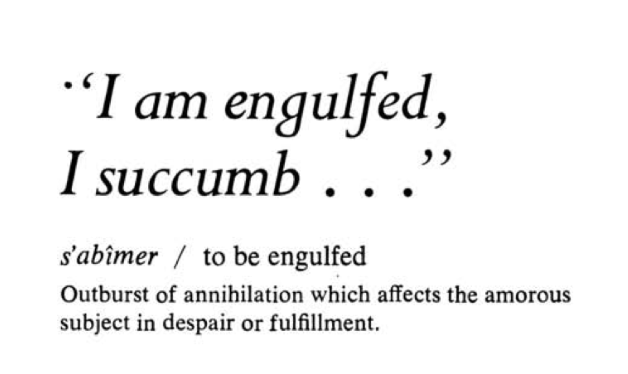

A craving to be engulfed; a moment of pure hypnosis and subjugation. When I read Barthes’ fragment on the lover desiring the “gentleness of the abyss”, I think of Paul Thomas Anderson’s 2017 Phantom Thread. Reynolds Woodcock, a London fashion designer and dress maker, requires ritual to stabilize desire, with Alma introducing calculated entropy – deliberate interruptions to his regimen that force him to relinquish control and become emotionally legible. A spell-binding tale of oscillating power dynamics, it sprinkles in some Freudian oedipal stuff and the most beautiful soundtrack ever crafted by Johnny Greenwood. When Barthes writes of the lover’s desire for engulfment in this chapter, he observes, “Engulfment is a moment of hypnosis. A suggestion functions, which commands me to swoon without killing myself. Whence, perhaps, the gentleness of the abyss: I have no responsibility here, the act (of dying) is not up to me: I entrust myself, I transmit myself (to whom? to God, to Nature, to everything, except to the other),” he may as well be writing of Alma routinely nursing Reynolds back to health from being poisoned.
Only in sickness does Reynolds permit himself to relinquish control; illness becomes the toxic, bodily condition that allows him to abandon autonomy, surrendering to Alma in exchange for care. Reynolds stating, “Kiss me, my girl, before I am sick” becomes “Will you destroy me, and will you care for me if I let you?” Georges Bataille wrote exhaustively about the relationship between eroticism and annihilation, in that the movement towards love becomes a movement towards death and dissolution of the self. Bataille posits that eroticism is inexplicably bound to death: not as a form of culmination, but as a momentary collapse of the self’s boundaries and the discontinuous states we find ourselves in. Phantom Thread displaces this erotic collapse from sex onto caretaking and control. In a way, I think Phantom Thread is the most erotic movie ever, made without even being very sexual.
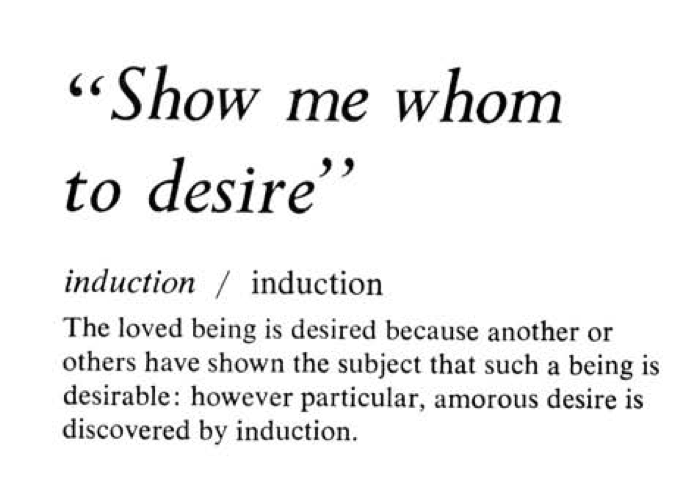

When Barthes writes of an image-repertoire, he’s describing what happens when someone develops an entire mythos of symbols, projections, images, phrases, fantasies, scenarios, etc., with regard to the loved subject. “The body which will be loved is in advance selected and manipulated by the lens.” The boys of Sofia Coppola’s The Virgin Suicides turn the life and decline of the Lisbon sisters into spectacles, mysterious objects to be analyzed and neatly categorized. The image-repertoire thus consists of Cecilia Lisbon’s unicorn-stickered diary, record music exchanged over the telephone, personal belongings taken during the garage sale aftermath of the sisters’ deaths, forensic reconstructions of the girls’ lives.
In Barthes’s formulation, desire requires just enough prohibition to come into being, and then demands the disappearance of the mediator; the Lisbon parents’ strict control becomes the initial prohibition, designating the sisters as desirable by making them inaccessible. But unlike Barthes’s structure in which the mediator withdraws to allow play, the prohibition here never quite loosens. The boys are left with nothing but curated images and sounds. Desire hardens into archive, producing a simulacrum of the Lisbon sisters that circulates independently of their interior lives. These fragments become substitutes for emotional intimacy, allowing desire to circulate without ever encountering the real, autonomous subjects behind it.
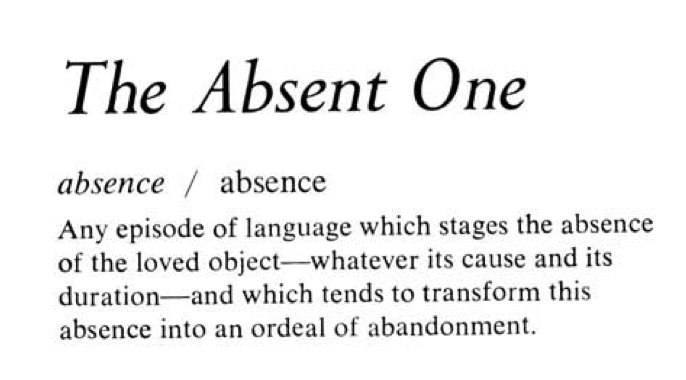

When Barthes writes of love and absence of the lover, there is always an inherent asymmetry: one waits, sighs, becomes sedentary and contemplative, and the other moves freely. The “sigh” is important for both Barthes and Kierkegaard: Barthes writes of the biological response to a lover’s absence as“tosigh: ‘to sigh for the bodily presence.’” For Kierkegaard, the silently suffering bird uses its sigh as its sole reprieve amidst heartache.
Blue Valentine centers around this asymmetry of longing for the loving past, around what it feels like to yearn for the memory of a relationship’s origin, yet be simultaneously haunted by its future absence. Dean stagnates, futilely holding onto what-once-was, as Cindy progressively dissociates from their unhappy marriage. It is a horrible feeling trying to reimpose the past onto someone else, to beg and place yourself at the mercy of the loved one to avoid abandonment: “Tell me how I should be. Just tell me. I'll do it,” Dean whispers, with Cindy already accepting that love has run its course.